

Battery storage can be a decisive part of agricultural energy planning when it protects timing, reliability and productive loads. It is not automatically the right answer for every farm. The useful question is: which operating window needs to be protected, and what is the most practical way to do it?
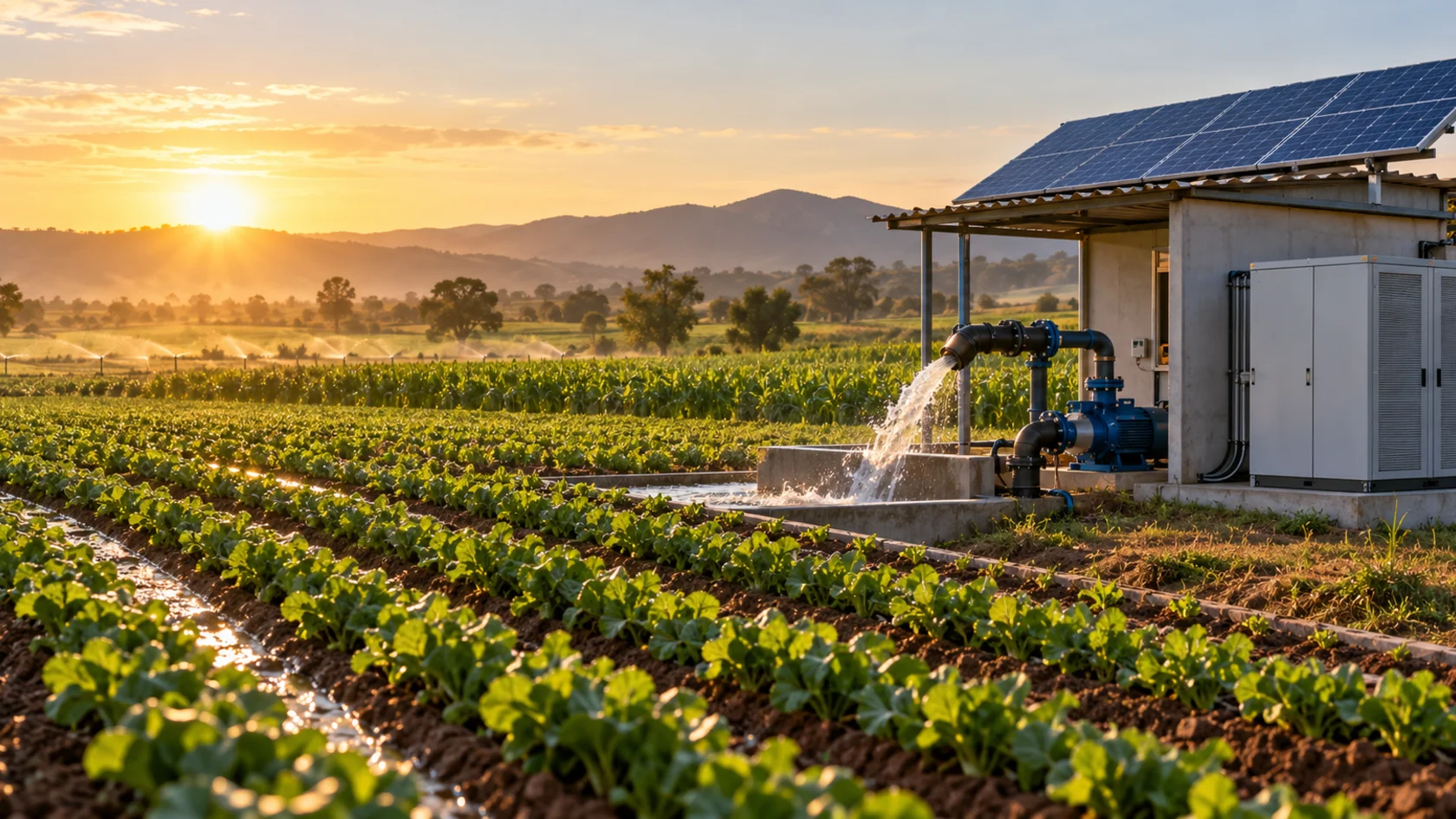
Start with the productive load, not the battery
Begin with the activity that creates value: irrigation during a defined window, a packhouse line, a cold room, a pumping cycle or essential communications. Record power demand, duration, seasonal variation, location and the consequence of interruption. This creates a decision basis before equipment is selected.
Separate critical, flexible and deferrable demand
Not every load needs the same level of continuity. Critical loads may need immediate backup; flexible loads can shift to solar-rich hours; deferrable loads may wait. This distinction prevents both unnecessary battery capacity and under-protection of the equipment that genuinely matters.
Align solar production, water storage and electricity storage
For irrigation, water storage can sometimes provide the operational buffer more economically than electrical storage. In other cases, battery storage is justified by evening demand, cold-chain continuity, poor grid reliability or a required pump profile. The design should test these options together rather than treating them as separate purchases.
Size for the operating window and duty cycle
A defensible concept documents the required usable energy, peak power, charge window, expected cycling pattern, reserve margin and the effect of temperature. The point is not to promise a generic autonomy figure. It is to show how the proposed configuration responds to a known operating need.
Include safety, serviceability and operating conditions
Storage decisions also depend on enclosure, ventilation, heat, dust, fire-safety measures, warranty terms, remote monitoring, installation quality and local service capability. A technically impressive component is not a complete solution if it cannot be maintained safely at the operating site.
Build an evidence-ready project file
For suppliers, financiers and project partners, a clear file should include the load profile, solar-resource assumptions, single-line concept, equipment data sheets, installation boundary, maintenance plan, commercial assumptions and open technical questions. This makes proposals comparable without overstating performance.
Key operational takeaways
- Define the productive load and interruption risk before selecting battery capacity.
- Use water storage, load shifting and electrical storage as one operating-system decision.
- Document site conditions, service access and safety requirements alongside energy calculations.
- Treat savings, uptime and payback as project-specific assumptions until verified.
Frequently asked questions
Does solar irrigation always need a battery?
No. Direct solar pumping, water storage and load scheduling may be appropriate in some cases. A battery becomes relevant when the operating window, reliability requirement or load profile cannot be managed practically by those measures alone.
What should a supplier include in an agricultural storage proposal?
A useful proposal identifies the site assumptions, power and energy basis, equipment scope, warranty, safety measures, service model, exclusions and commercial validity period.
Can a battery project be assessed remotely?
An initial concept can be assessed remotely using a structured evidence pack, but final technical design and performance assumptions require appropriate site-specific validation.
Source framework
These sources inform the operational context. Any project, product or commercial decision still requires site-specific technical, legal and financial review.
Battery storage becomes useful when it protects a productive operating window, not when it is added as a generic specification.
Move from an initial idea to a clearer, accountable next step.
Explore solutions